

TOTS Spring 2026 Q/A + A Quick Primary Preview!
The first Q&A in a LONG time! Also there are some elections coming up, so let's take a quick look at that.

Hey folks, happy Tuesday!
It’s been a minute! I actually couldn’t remember the last time I posted here, so I looked and it’s been nearly two months, which feels kinda crazy. That’s partly due to busy personal life commitments, and partially due to a rare quiet month on the election calendar in an otherwise insane year (That is now getting back into full swing).
Of course, it wasn’t all silent. Democrats scored a couple more big special election overperformances, got a huge win in Wisconsin, and put largely neutralized the Republican redistricting efforts of the past year when Virginia voters approved a plan to gerrymander the state's congressional map. Beyond just outright election news, Trump’s approval rating has continued to slide in the wake of the war in Iran (Which has become a historically unpopular anchor on the President), the Supreme Court issued a severe hit to the Voting Rights Act that has several GOP states scrambling to redraw their congressional lines before the 2026 midterms, Florida countered Virginia with a gerrymander of its own, and a record-breaking shutdown at the Department of Homeland Security finally came to an end last week (Although it may very well shut down again soon). There’s been a lot!
One of my most consistent desires for this blog has been to cover stories that are not about elections. Make no mistake, elections do tend to be my bread and butter, and I enjoy writing about them, but they are really only a small part of the puzzle, and many of the most influential and consequential stories in politics today are much quieter affairs. I hope, in a less chaotic state of life, I will be able to do more posts like that! But for now, I post about elections, and I make time to fit other stuff where I can.
But I do need your help! Long-time subscribers may be familiar with my past Q&A posts, which I have now done three of! I love doing these posts because they are not only a great way to engage with the many of you so kindly taking time to read and support the blog, but because they give me a chance to talk about and cover things that are not necessarily elections-related. If you’ve been around for a while, you probably know how this works, but for the many who were not here for my last Q&A, you can basically ask me anything (preferably politics related, but I don’t dimiss any questions out of hand) and I will share my answer in my next post (Most likely about a week from now). If you want to ask a question, submit them by either commenting on this post or emailing me at tuningoutthestatic@gmail.com. (I prefer these methods because it gives me a record of questions so that I can copy + paste said questions into the post. Also, I think it’s good if other subscribers can see them.) And yes: Anyone can ask as many questions as they’d like. As long as you get them to be in the next week, I’ll answer them all.
As always, thank you so much for subscribing and please, ask a question! I don’t bite. Anyways, there are going to be a couple states holding primaries tonight, so I wanted to give those a quick discussion before wrapping up. Without further ado!
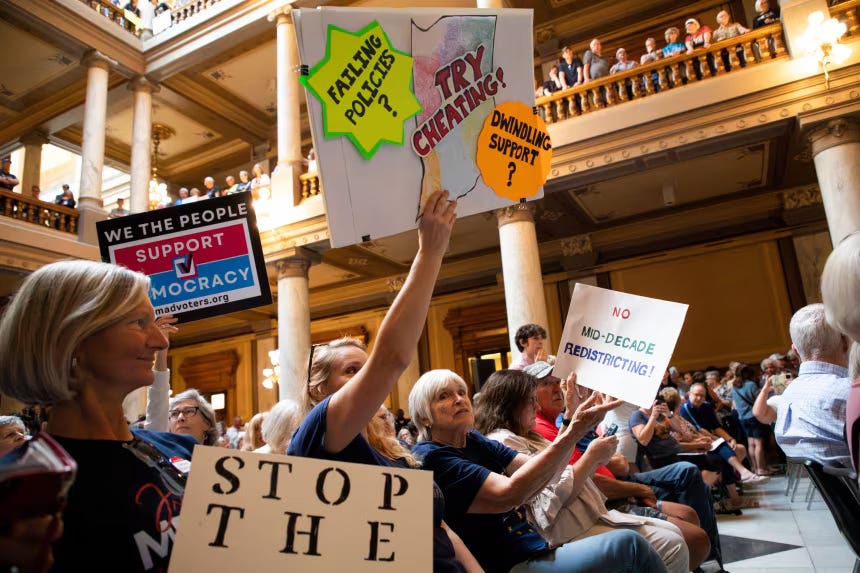
Indiana: A Major Test for Trump
One thing that I’ve always appreciated about my work on this blog is my ability to put the finger on the pulse of what my audience is really interested in. I know why you come here, and it’s not for elections predictions, political takes, or my wry wit, it’s to read about the 2026 State Senate elections in Indiana.
Ok, but all jokes aside, we should really talk about these, because while the composition of the Indiana State Senate’s next session is very unlikely to affect most people outside of Indianans, these races actually have some very real implications for the rest of this primary season. Let’s start from the top: First off, if you haven’t, check out my August post on the gerrymandering arms race. At the time, Texas was the only state to produce new maps, and while California was clearly racing towards the same outcome, it remained quite unclear how big the race would get. While as the California and Virginia votes show, pretty big! (And that’s before getting into Republican-led redraws in Florida, Missouri, and Ohio). At the time, one of the many, many states discussing a mid-decade redistricting effort was Indiana—and the White House took particular interest in the Hoosier State, as I wrote back then: “The WH is engaging a full-court press to get an Indiana redraw here, with J.D. Vance recently visiting the state with the threat of potential primaries in hand. Indiana state law makes it a tad complicated (The state also has a backup commission), but with a Republican supermajority, changing that to draw a gerrymander would be fairly easy. Notably, the entire GOP Congressional delegation has backed the effort, which seems to be gaining steam, a wild thing to think after the delegation rejected the chance to do this back in 2021. Hilariously, this is all happening in a state that, in all likelihood, would only add one seat to the GOP’s total. What to watch: There is legit opposition to this in the State GOP. Can Trump force their hand?”
On paper, Indiana made a ton of sense as a GOP redistricting target. A Democrat hasn’t won statewide since 2012, Trump won the state by just under 19 points in 2024, and Gov. Mike Braun (R) possessed Republican supermajorities in both chambers of the General Assembly to play with. Democrats currently hold two seats in the U.S. House from Indiana, and both of those seemed like goners, especially once Trump got involved. And yet… as I noted in that original post, the Indiana GOP never seemed totally on board with Trump’s plan. That article I linked listed 4 Republican opponents to the measure in the state legislature, and even more offering concern. Why the lack of enthusiasm? Hard to say, really. Maybe a strangely principled group of politicians. Maybe a lack of support from constituents. Maybe they got sick of having to spend time with JD Vance.
I won’t rehash the entire Indiana redistricting cycle to you all here, but needless to say it was a huge mess. Trump loudly and publicly went after Republicans who were on the fence about the measure, making it clear that any Republican who voted against it would face a Trump-backed primary challenger, and even allies like Braun were placed under the gun for failing to push the effort through. At least 11 Indiana Republican legislators were targets of bomb threats threats and swatting during the redistricting debate, one of whom had been directly attacked by Trump in a TruthSocial post about the issue. The threats went beyond just opponents of the measure, with even Braun and undecided legislators reporting threats to family members and businesses. A White House invite to opponents and undecideds didn’t seem to swing many votes, and while the legislation passed the State House 57-41, it did so with 12 Republicans defecting to vote against the President. While some legislators did flip, the pressure campaign and threats only seemed to harden the will of others, who surely couldn’t have been too impressed when hard-right Lt. Gov. Micah Beckwith claimed Trump was threatening the state's federal funding over the measure, a very much last-ditch effort just before the bill fell 19-31 in the State Senate, with 21 Republicans voting against it.
If you have followed Republican politics at all in the last decade, you may be aware that the President is not exactly used to being told “no” by his own party. And while bluster is a major part of his persona, Trump was very much not bluffing about those primaries. 9 State Senators who voted against the redistricting measure are up for re-election this year; 8 of those 9 are actually running for re-election; 7 of those 8 face a Trump-backed primary (The eight faces what I suppose one would call a normal primary). In addition to Trump’s support, many of these primary challengers tout the strong support of Braun, Beckwith, and U.S. Sen. Jim Banks (R) (Who, despite not really being involved in the original fight, has become a key figure in the on-the-ground campaign here), all of whom are staking a lot of political capital on this. It probably would not shock you to hear that the primaries for state Senate in this deep-red state are usually sleepy affairs. And yet, combined spending in these races has broken $8 million, with the primary campaign largely funded by a pair of dark money groups connected to Banks. The conservative groups Club for Growth and Turning Point USA have also both gotten involved in mail and ground campaigning, and conservative “activist” Scott Presler was recently deployed to the state to campaign on behalf of a group of primary challengers.
Despite all of this attention, it’s not clear that Trump will have a good night. While these incumbents are certainly in the fight of their lives, Beckwith has already issued some expectations management, suggesting it would be a win even if only three were to ultimately lose, a bit lower than the 8 being targeted. Trump-backed challengers have often struggled to break out, with questions about their background and campaign focus coming into the forefront (Shockingly, it’s hard to stake an entire primary challenge off one vote that has little to do with policy). Still, some Trump allies seem to think they’ll be taking at least 5 incumbents down tonight, which the President would certainly victory lap.
I won’t go into detail on each of the specific races, but here they are for those looking to track!
District 1: State Sen. Dan Dernulc faces Trump-backed Trevor De Vries (There is a third candidate, Nader Liddawi).
District 6: State Sen. Rick Niemeyer faces Jay Starkey (For reasons I couldn’t really make clear, Trump has not gotten involved here, but Niemeyer voted against redistricting and has been targeted by Braun/Beckwith).
District 11: State Sen. Linda Rogers faces Trump-backed Brian Schmutzler.
District 19: State Sen. Travis Holderman faces Trump-backed Blake Fiechter.
District 21: State Sen. Jim Buck faces Trump-backed Tracey Powell.
District 23: State Sen. Spencer Deery faces Trump-backed Paula Copenhaver.
District 38: State Sen. Greg Goode faces Trump-backed Brenda Wilson (There is a third candidate, Alexandra Wilson).
District 41: State Sen. Greg Walker faces Trump-backed Michelle Davis (Fun fact: Walker had originally annouced plans to retire; not only did the pressure campaign not change his vote, it may have gotten him to run again)
For the record, the ninth incumbent to vote against redistricting up this year is State Sen. Eric Bassler in District 39, who annouced his intention to retire before all of this ever happened. Trump and Banks have backed Jeff Ellington to replace him, so the President may also be keeping an eye on Ellington’s ability to ward off a challenge from Kristi Risk.
So, with all that out of the way, is there really anything to care about in Indiana from a federal perspective this year? Eh… sorta…
There’s only one House district that sticks out as potentially competitive on paper, and that’s IN-01, an ancestrally Democratic and industrial seat home to Gary in the state’s northwest corner. Like many Midwestern seats, IN-01 has trended to the right as manufacturing jobs have left the community, and Kamala Harris only won the seat by a third of a percentage point in 2024, seemingly making it a ripe target for the GOP. That hasn’t exactly played out however—Rep. Frank J. Mrvan (D) retains significant crossover appeal in a district that remains blue-leaning, especially downballot, as his over 8 point win on that same 2024 ballot shows. Republicans haven’t put up much of an effort to flip the seat this year—2022 nominee Jennifer Ruth-Green was running again, but her time as Public Safety Secretary in Braun’s administration ended in scandal, and she dropped out. Now, Republicans have largely consolidated around Porter Co. Commissioner Barb Regnitz, who has poured a hefty amount of her own money into her campaign, and seems to be a strong favorite over a couple opponents in the primary. Check this one out more closely in 2028.
Maybe IN-05 could be close? The wealthiest district in the state (based in the northern Indianapolis suburbs) flirted with becoming purple in the late 2010s, before Republicans put a stop to that in the 2020 redistricting cycle. At just under Trump +17 in 2024, it’s far from a credible target for Democrats, but things have seemingly gotten worse for Republicans every single day the war in Iran drags out and prices worsen. There are levels the GOP can pull to avoid a historic shellecking in 2026, but they haven’t pulled those yet, and if things worsen, a seat like this could come on the board as a long-shot for Democrats. Rep. Victoria Spartz (R) has become well-known for a… we’ll call it, eclectic style of governing and nearly lost her 2024 primary after initially retiring before changing her mind at the last minute. State Sen. J.D. Ford looks favored to be the Democrat, and set to run a stronger campaign than the party has mustered in the seat the last couple of years.
A couple safe-seat primary challengers also bear mentioning: In deep-red IN-04, Rep. Jim Baird considered retirement for the second straight cycle (With his son Beau waiting in the wings to take the seat), but opted to run again. And for the second straight cycle, state Rep. Craig Haggard mulled a bid—and this time pulled the trigger, interrupting the attempted succession plan. Baird has never been a prolific fundrasier, and while he’s supported by Trump, Haggard has successfully pulled the support of state AG Todd Rokita, indicating some energy around his bid. Could be a caught-sleeping situation. Likely safer is Rep. André Carson in the Indianpolis-based IN-07, the state’s bluest seat. Carson has never faced a serious primary challenger, but former state party official and Obama Administration staffer George Hornedo raising some legit money, and Destiny Wells, the party’s nominee for Secretary of State in 2022 and Attorney General in 2024 potentially possessing some name recognition. Both challengers have made an anti-incumbent pitch against Carson that while, unlikely to succeed in this situation, has become a staple of many Democratic campigns in 2025.
O-H-I-O
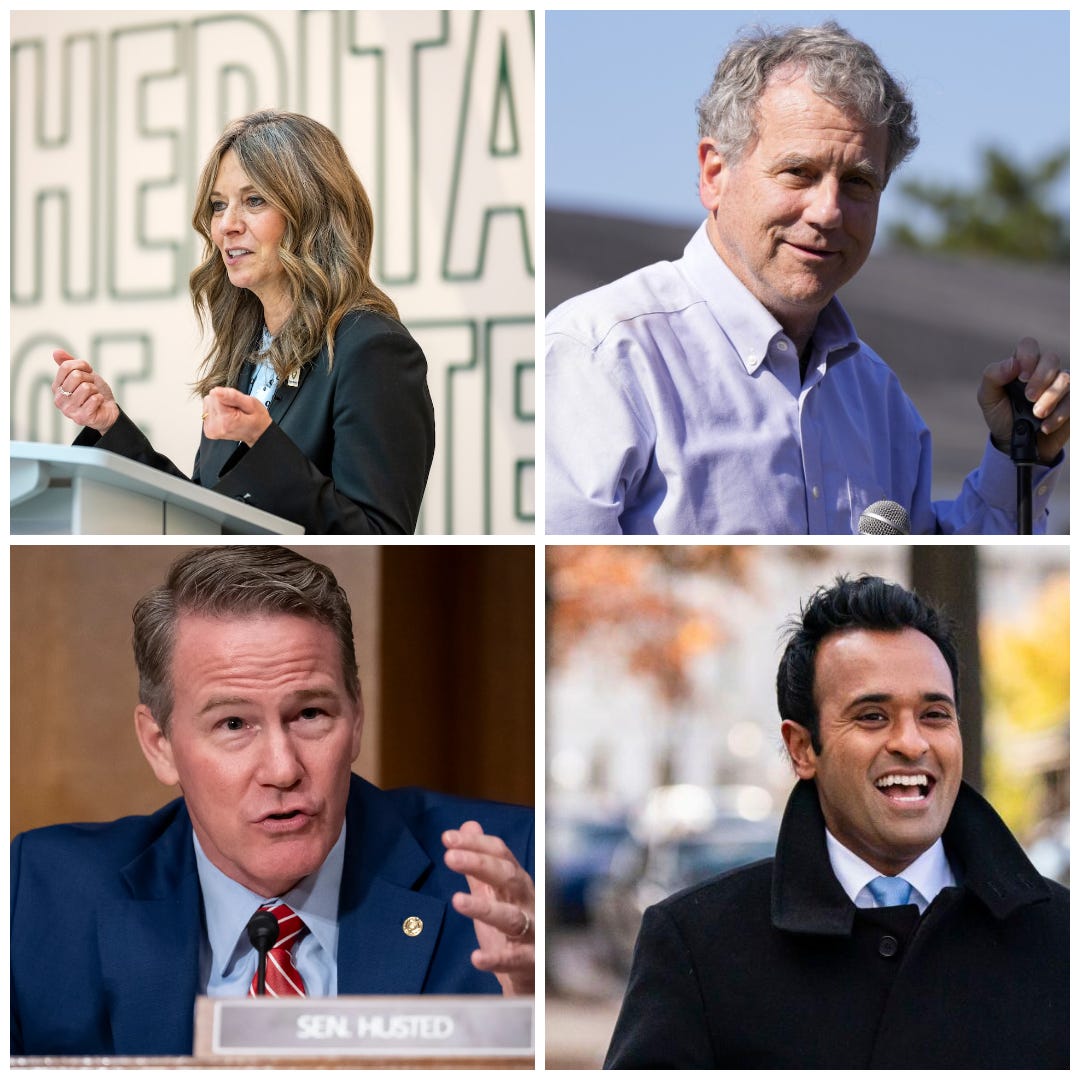
The Buckeye state will be one of the most closely watched in the nation come November for several reasons, something of a surprise status for it. Once the country’s premiere purple state, Ohio has become a firmly red-leaning one in the Trump era, backing the President by over 11 points in 2024, the biggest win for any presidential candidate in the state since Ronald Reagan in 1984. Still, with the year looking quite promising for Democrats, the party is hoping Ohio can flash a purple hue for quite possibly the last cycle for some time. Recruiting former Sen. Sherrod Brown (D), who lost his bid for a fourth term in 2024 despite far outrunning Kamala Harris, was a coup for Senate Democrats, as Brown now seeks the seat once held by his ex-Senate colleague JD Vance in an arguably must-win race for Democrats if they are to flip the majority. With that said, neither Brown nor appointed incumbent Jon Husted (R) face real primary opposition, so this race doesn’t matter to us much yet.
The same is largely true of the gubernatorial race. A Democrat hasn’t won the Governor's mansion in Ohio since 2006, but Republicans have landed quite the controverisal candidate in biotech billionaire turned culture war stoker and former 2024 presidential candidate Vivek Ramaswamy. After his short-lived GOP primary bid made him a rising star in the GOP, Ramaswamy quickly killed much of his good will, and was forced out of DOGE before Trump even took office for a new term. Ramaswamy quickly jumped into the gubernatorial race, quickly clearing the field—with the exception of automobile entrepreneur Casey Putsch, who has made little headway in the polls but has made lots of headlines for his racist dogwhistles about Ramaswamy's heritage. Putsch has little chance of winning the primary, but Ramaswamy’s flaws as a candidate are real—Democrats feel very strongly about the chances of former state health director Amy Acton. Beyond that, the question of how appealing Putsch’s open-fire racism may be to some GOP primary voters is one that will certainly be answered tonight.
The more interesting races in Ohio are largely for the House, where GOP leaders also introduced a redistricted map—although they ultimately compromised with state Democrats to make it. The result of that is a much better than expected map for Dems—for example, OH-13, a northeast Ohio seat that contains Akron, went from a Harris +0.1 seat to a Harris +3 seat. While not a huge jump on paper, Rep. Emilia Sykes (D) saw her most credible Republican opponent, former state Senator and 2024 nominee Kevin Coughlin drop out after the change, giving Republicans a mess of a primary without a clear strong favorite. (Local radio host and former meteorologist Carey Coleman, who has barely raised any money, is perhaps a nominal favorite, but it’s an uninsipring field).
Besides outright helping Democrats in the 13th, the new map really didn’t make life much worse for the state’s other two swing-seat Dem incumbents. Rep. Greg Landsman’s (D) Cincinnati-based seat, OH-01, did see a pretty significant territorial change (Although it remains achored in the city), going from a Harris +7 seat to a Trump +3 seat. While that certainly could be problematic for Dems in the future, Landsman is a fairly durable incumbent, and Trump +3 may just not be anywhere close to red enough to do it for Republicans this year. The party has consolidated around a serious candidate in Air Force vet and ex-CIA operative Eric Conroy (Although he’ll have to put away saleswoman Holly Adams in the primary first), but most experts seem to agree it’ll be hard to dislodge Landsman in this year of all years. (One note: Landsman faces a primary challenger, and while he won’t lose, I wonder if he’ll see any backlash for being one of just four Democrats in the House to initially vote in support of Trump’s Iran War).
While Landsman did get a bit of a raw deal, it may be nothing compared to Rep. Marcy Katpur in OH-09. The longest serving woman in U.S. House history, Kaptur spent decades representing a safe blue seat, but since 2022, her northwest seat along the coast of Lake Erie (which includes Toledo) has been a landmine. Kaptur has pulled out two remarkably impressive wins, including narrowly clinging to her seat in 2024 even as Trump won it by 7 points. The new map pushes the seat up to Trump +11, an even tougher challenge—but perhaps not enough to stop Kaptur. As noted earlier, most experts favor Landsman to win a Trump +3 seat in a very strong Democratic year. Having already shown she can win a Trump +7 seat—in a year where, despite becoming slightly redder, I’d bet on OH-09 not producing a Trump +7 electorate, it’s quite easy to see the logical path for Kaptur. Still, she faces a host of potential challengers. State Rep. Josh Williams leads the GOP field in cash, and is backed by GOP heavy-hitters like Ohio Secretary of State Frank LaRose and Ohio House Majority Leader Marilyn John. Former state Rep. Derek Merrin came up just short against Kaptur in 2024 (Though some would argue coming up short at all was the problem) and likely maintains sizeable name recognition. Perhaps the candidate capturing the most media attention is Madison Sheahan, the former Deputy Director of ICE, whose entry into the race proved to be an unwelcome surprise for many local GOP leaders. Sheahan resigned from ICE in January, as the agency dealt with the fallout of the muders of Renee Good and Alex Pretti, and Republicans have reasonably worried her record could prove quite problematic in an election cycle where ICE is not likely to be a winning issue for the party. Air Guard Lt. Colonel Alea Nadeem is also in the race.
Most of the focus on Ohio this year will be on the potential Republican targets, but will Democrats have any opportunites to flip seats? Nothing obvious, but yes! I’m most closely watching OH-15, a centralish Ohio seat which takes up most of the area between Dayton and Columbus and barely changed in redistricting (Trump +9 to Trump +10). That margin is certainly gettable for Democrats this year, and Rep. Mike Carey (R) hasn’t really been tested with a tough campaign before. Former state Rep. and 2024 nominee Adam Miller seems like the favorite to win the nomination for a second go-around, but Ohio State University educator Don Leonard is also in the race.
OH-10 feels like the clearest target for Dems to me, but they’ll also likely be competitive in all of OH-07, OH-08, and OH-10. OH-07, a northcentral seat taking up most areas just West of Cleveland, was unchanged margins-wise in redistricting (Trump +11) and is thus only slightly redder than OH-15. Rep. Max Miller (R) is looking at a crowded Democratic field to challenge him, though Brian Poindexter, an ironworker and local city councilman has pulled endorsements from big outside names like Sen. Bernie Sanders and Rep. Ro Khanna, and big inside names like ex-Rep. Tim Ryan and Ohio Senate Minority Leader Nickie Antonio. Former Cuyahoga Co. Executive Ed FitzGerald has raised the most money, though it may be hard for some to forget his 30 point loss in the 2014 Governor’s race. Other candidates on the ballot include attorney Michael Eisner, local education official Scott Schulz, and community organizer Laura Rodriguez-Carbone.
OH-08 sits on the Ohio-Indiana border, stretching all the way from Greenville into parts of Cincinnati, and actually got quite a bit bluer in redistricting, going from Trump +21 to Trump +15. While that still makes it a pretty sizable long-shot for Democrats, much like the aforementioned Indiana seat, it’s hard to totally dismiss it out of hand. Unfortunately for Democrats, Rep. Warren Davidson (R) is unlikely to face a very serious challenge from businessman Madaris Grant, who has raised very little money, but has also raised way more than the $0 brought in by his only opponent.
Finally, OH-10 stands out as an intresting case study. The southwest Ohio seat is home to Dayton and was only Trump +5 in 2024—but Rep. Mike Turner (R) put up a huge overperformance, winning by nearly 20. The new map makes OH-10 a hair under Trump +8—a bit redder, but very much a real target for Dems in 2026—if they can crack Turner’s overperformance. Turner easily won in the most recent Dem wave—2018—making this seat feel like a much greater longshot than it really is. Electrician Tony Pombo, who ran here in 2024, and Air Force vet Kristina Knickerbocker, who’s backed by Emily’s List, feel like the frontrunners on the Dem side here, with no one else really campaigning or raising money.
And that’s it! Not the most exciting primary day, but important nontheless in my view! Once again, please remember to comment or email your questions for my next post—I answer all that I get, and I don’t do these super often, so don’t miss your shot.
As always, thank you for reading and please share and subscribe if you are so inclined.
I hear a lot about the MAHA coalition from legacy media, but I don’t really see the vision. Is the MAHA coalition a genuine factor in Republican politics and does that give RFK Jr an opportunity in any future bids for higher office?
Q: Have Democrats actually seen a Tea party in 2026? If so will it continue into 2028?